
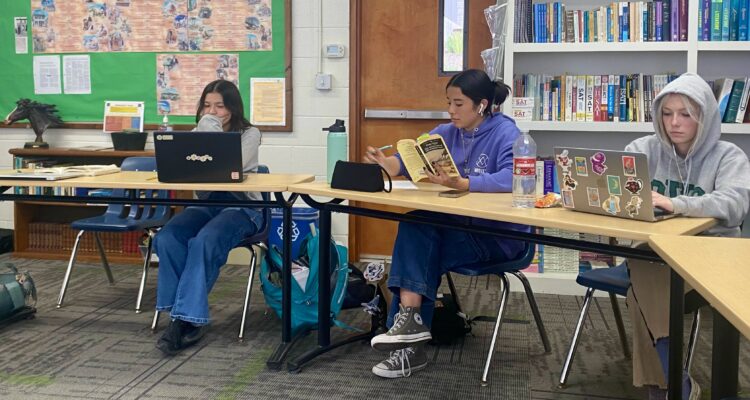
Last month, the 11th grade English students at OVS began their annual study of The Adventures of Huckleberry Finn, a book notorious for being banned in libraries and schools alike.
The story has been under scrutiny since its publication in 1884, due to its explicit language and mature themes. Despite this controversy, English teacher Terry Wilson considers Huck Finn to be one of the great American classics and deserving of a place in school curriculums.
So the question becomes, here at OVS Upper Campus, why do teachers teach what they teach?
“I teach [Huck Finn] for the relationships between African Americans and white people, and the fact that Mark Twain portrays Jim in such a human way,” Ms. Wilson explained. “And I think [Twain] is one of the best of all the American writers, so I want to include something he wrote in a course for American literature.”
Ms. Wilson does not think that the novel should be discarded because of the use of the n-word, and she herself, doesn’t shy away from directly quoting the text.
Some 10 years ago she was interviewed by On the Hill for her decision to stick to the original text rather than a new edition which substituted the slur for “slave.”
“Huck Finn is an American classic, and it needs to be read how it was written,” she said then.
Twelfth grade English teacher Crystal Davis has a different approach: she no longer teaches books with the n-slur. She feels that modern culture has become so fraught that to do so would pose a risk to her reputation, maybe even to her career.
Ms. Davis said she doesn’t want any of her students to misinterpret her feelings, taking that language out of context and attributing it to her for whatever motive.
She highlighted the book Heart of Darkness, which she used to include in her curriculum, but recently removed due its derogatory language.
“I think that’s saddening to me as a teacher, to think that there is an amazing book that I could teach to students that would help them understand the effects of colonialism … that I, cowardly, do not teach anymore,” she said.
Humanities teacher Fred Alvarez took the middle ground, saying that this language can be taught with caution.
“It can be uncomfortable at times.. for sure,” he said. “But I think that the discomfort is outweighed by the value of what we’re trying to teach.”
How do our English and History teachers select said “valuable” material? How can they shape their curriculums to promote diversity and inclusivity, while also honoring “traditional” literature?
“It’s incumbent upon teachers to ask themselves this question all the time,” Mr. Alvarez said. “How am I diversifying the voices that our students are listening to?”
Mr. Alvarez believes it’s up to us to do a better job. In his eyes, we’ve got to be intentional, or else OVS will continue to teach what’s always been taught.
But who should be addressing the problem? All of us, according to Mr. Alvarez. It’s a discussion that should be had in high up places, in classrooms, and in our homes.
“I think students should be holding us [teachers] to task,” he said. “I think they should be asking why we are studying this and not that.”
Some OVS high schoolers are asking these questions of themselves but have yet to communicate their thoughts and ideas with teachers.
Senior Hannah Little recently studied Hamlet and Othello and expressed curiosity as to the selection.
“Sometimes I question why we study so much Shakespeare and… why we don’t study more recent literature,” she said.
Senior Lucas Felipe spoke from his perspective in an English classroom.
“It’s not the easiest thing being a black kid and having an… older white person, in a room full of… white people, talk about slavery and teach you about something… which is a difficult part of your history,” Lucas said.
The feeling among most students interviewed is that OVS teachers aren’t doing a poor job setting their curriculums, but that they could be making a more active effort to introduce diverse material and to “branch out” from the same texts that have been taught for decades.
The OVS English classes study a majorly white and male reading list. In English 11, for example, only one book of the 14 summer reading options is written by a black author, and only one is written by a woman.
Ms. Wilson explained that she bases this list on periods of American history, and there just aren’t many books written by people of color until the modern period.
Still, how can these novels truly represent American literature when they exclude minority perspectives?
Ms. Davis pointed out that white-authored books are not always absent of diversity in their content.
“I think a good teacher and I think thoughtful students, which mine are generally… are able to understand and to glean those themes – those critical topics – in everything that they’re reading,” she said. “We have to be careful not to discount a book, just because it happens to be written by a white guy, as not being able to confirm a message that’s important to racial issues.”
Perhaps it doesn’t need to be an either-or proposition. Perhaps these classic – and often controversial – works can continue to be taught, but new perspectives integrated too. One could argue a well-rounded curriculum contains both.
Tyson Luneau, World and US history teacher, makes this argument.
On some occasions he refers to standard textbooks, while at other times, he pulls from the first hand accounts of Native American, African American, and other minority groups, which are often underrepresented in history.
“There comes the question of… can a white historian adequately research, write about, and present that history, and I think the answer is yes,” he said. “But I think the caveat has to be really trying to get those voices through the sources.”
Ms. Davis agreed that there can be room for both traditional and “diverse” narratives in school curriculums.
“I think we can teach Mark Twain and we can teach Frederick Douglass,” she said. “I think the important thing in a literature class is… who is able to bring that experience better to the life of the readers? That’s my criteria, not the name, the color of the person who wrote the book, but how well does this book bring this experience to life? Because that’s at the end of the day, I want my students to feel.”
Mr. Alvarez used the same vocabulary.
“Our goal – our job – is to get you to feel [the story]… maybe even to get you to act on it,” he said.