
 Walkouts and sit-ins. Deafening silence and echoing chants. Racial slurs and civil unrest. Students with nothing to lose but their chains.
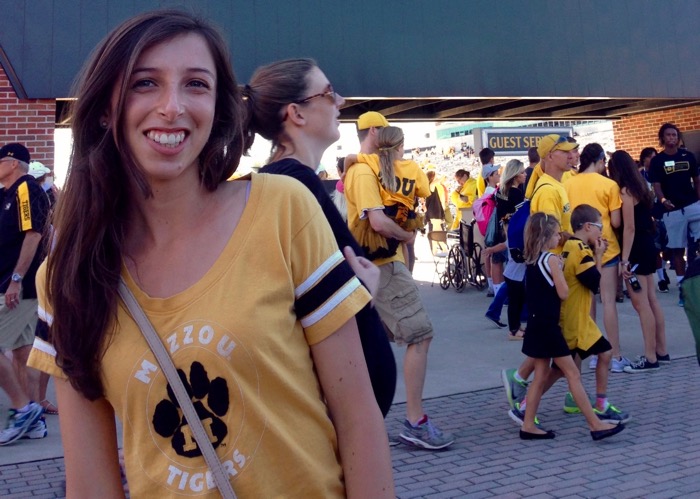
In recent months, the University of Missouri has been overpowered by overwhelming racial tension that has upset many of its 35,000 students. Standing their ground with countless protests and boycotts, students at that university, commonly known as Mizzou, were demanding to be heard, and Ojai Valley School alum Daphne Psaledakis had a front row seat as the race wars unfolded.
Daphne, a freshman pursuing her dual degree in print and digital news and international peace studies, gave On The Hill an inside look at the events that have shaken her new school, which is located in Columbia, Mo.
“I’ve grown up in what I guess are fairly liberal communities mostly around California and Colorado, where racism was an idea and never something I actually witnessed,” said Daphne, who graduated from the Upper Campus last spring. “I think a part of me didn’t even believe it existed until I came to school here. I’m white, and have never had any personal experience as a target of racism, and it is unlikely that I ever will.”
That all changed soon after Daphne set foot on her new campus.
Racial unrest was not the first issue the university has wrestled with this year – during the first week of school graduate students held a walk out regarding health care. But no issue has been more explosive than the racial divide that has long existed on the Mizzou campus.
For years, the university has struggled to find ways to address issues of race and diversity, and Daphne said the Mizzou Hunger Strike arose from the administration failing to address those issues.
Gas was added to the flames of hatred during the homecoming parade in October when the president of the University of Missouri System, Tim Wolfe, was in a car with a driver that revved the engine and nudged some of the protestors that had blocked the road.
“Wolfe, rather than issuing an apology for the incident, chose to ignore it and didn’t apologize until earlier (last) month as the protests really began in earnest,” Daphne said.
On November 2, University of Missouri graduate student Jonathan Butler announced his decision to go on a hunger strike until Mr. Wolfe took his concerns, as well as the concerns of activist group Concerned Student 1950, seriously.
Concerned Student 1950 is a group of students who have banned together to take on many challenges facing the students of the university — primarily, racism.
Not only were the students calling for Mr. Wolfe’s resignation, they also compiled a list of demands they wanted the university to meet. Those demands included a 10% increase in the percentage of black staff and faculty by the 2017-18 academic year, and more funding, resources, and personnel for the social justices centers on campus for the purpose of hiring additional professionals, particularly those of color.
Although Mr. Wolfe stated he was concerned for Butler’s health, Daphne said he did absolutely nothing to ensure the health and safety of one of his students.
 Not even the hunger strike was enough to make changes, so the students decided to hit the school where it hurts – football. On November 7, the football players of the University of Missouri announced that they would not play until Mr. Wolfe stepped down.
If the athletes didn’t play it would have cost the university $1 million, Daphne said. Mr. Wolfe resigned the following Monday.
“It’s pretty amazing that we (as a student body) were able to accomplish that,” Daphne said. “An article by the New York Times summed it up perfectly: ‘The Missouri athletes showed that the color that matters most is green.’ ”
Mr. Wolfe’s resignation did not end the racial conflict.
African-American students continued to be subject to racism, including racial slurs at the homecoming game, cotton balls sprinkled in front of the black culture center, and the distribution of racist graffiti and flyers.
On the night of November 10 an anonymous user on the popular social media application, Yik Yak, posted a threat saying that he was going to shoot every black person he saw on campus.
Later that night, Daphne said a pick-up truck full of white males cornered a group of black females, further ratcheting up racial tensions.
The rumor mill began the churn out more and more stories, some of them even going as far as to say that students who were members of the Ku Klux Klan were throwing bricks into the dorm room windows of black students, Daphne said.
With the influx of rumors, students began to feel unsafe of campus. Some even went as far as emailing their professors, saying that they didn’t feel safe attending classes because of the constant threats.
“I think racism is embedded here at the university, it has been since the very beginning,” said Daphne, noting that Missouri was a slave state and there are buildings on campus that were built by slaves. “People have driven around campus with the confederate flag proudly displayed in the bed of their truck, and the N-word isn’t a rarity.”
However, Daphne said the media has blown some of the acts that have taken place on campus out of proportion. Certain news outlets have stated that a swastika drawn with feces on one of the bathroom walls was the act that ignited the protests. As a journalism major, Daphne has said it has been interesting to see where the holes are in those stories.
Daphne said the most shocking thing she witnessed happened in the Speaker’s Circle – the one place on campus with absolute freedom of speech. A white supremacist group took over the circle with chants of “go back to Africa, you don’t belong here.”
Because Daphne hasn’t experienced any direct racism at the university, she asked one of her African-American friends what her thoughts were.
“People used to smile at me in the halls before, now they don’t even make eye contact with me,” Daphne recalls her saying.
While it has been a tumultuous time – a time filled with fear, anger and resentment – Daphne feels she has been a part of something monumental.
“I’m proud to have been a part of something that I believe in and that has sparked a nationwide movement,” said Daphne, noting that more than 100 schools have shown their support for the movement at Mizzou, and that other universities – including Yale, Ithaca, and Chapman University – have begun demanding changes at their own colleges.
“I had the opportunity to witness something beautiful and empowering; to witness students fighting for what is right,” Daphne added. “Change needed to happen, and so students took the initiative to make sure that it did. I couldn’t be prouder of my school.”