
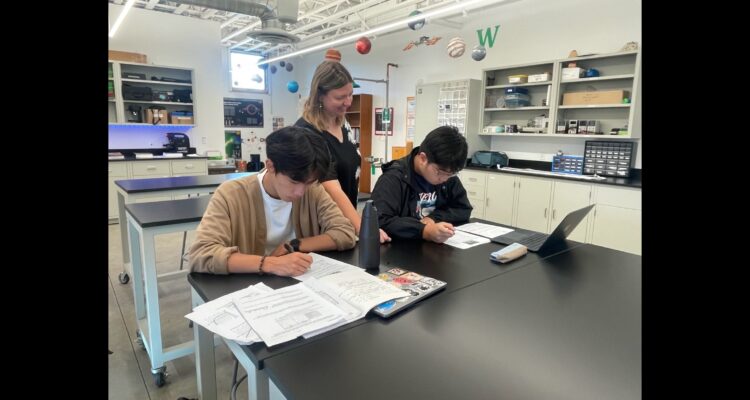
It’s not uncommon for OVS students to come from overseas. It’s hardly noteworthy if they needed to fly a dozen hours or so just to start the school year. But when it comes to OVS’s current teachers, Ms. Shepherd may be the only one who went through a similar process as OVS’s many international students do.
Allyson Shepherd, a former chemist and lab employee who worked across the United States, packed her bags seven years ago to live in Seoul, South Korea, and packed her bags again to move to Ojai. Over the last few weeks, she has established herself as a boys’ dorm parent, a assistant volleyball coach and a teacher of three rigorous science classes.
“I first moved to South Korea because I wanted to travel and try life in a different culture,” Ms. Shepherd said. “I stayed there because it’s very safe for raising young children, however a lot of South Korea is very competitive academically…I felt bad that my students spent all day in school.”
She went on to say how she appreciated OVS’s philosophy of “wholeness of life,” “that there is more attention given to the whole person, not just ‘what’s your letter grade in this class.’”
Ms. Shepherd applies this holistic approach to maximize her students’ potential within and outside the classroom. For the girls’ volleyball team, she runs drills, fills out the rather complicated scorebook, and functions as an “unofficial cheerleader” of sorts.
“It’s fun to see what students do outside of school because when you see them in class, you don’t really know much about them, what their lives are, what their hobbies are,” she said. “You learn about their dynamics, like who’s friends with who.”
Within Ms. Shepherd’s Astronomy, AP Biology and AP Physics classes, students can agree that the material is challenging. But Shun Tateno, a junior taking AP Physics, takes that difficulty with stride.
“Mrs. Shepherd teaches AP Physics in an engaging manner,” he said, “ensuring that the students understand the material and then providing work that will help us further understand the topic…I would be willing to take another class with Ms. Shepherd next year.”
Fortunately, Shun’s response fits fairly well with how Ms. Shepherd envisions her purpose in teaching. She worked in labs across the country, she worked for the government to test Kansas City’s water quality, and in comparison teaching may seem to be a more menial job.
Ms. Shepherd did say that being a scientist allowed her to understand the planet, on how humans are connected, but the monotony of lab work detracted from some of that initial wonder. She said wanted variety, to do labs with other people, and most importantly to help them to understand some of that curiosity that drives all scientists.
And this year, Ms. Shepherd is ready and willing to achieve that goal.
“I wanted to be a scientist because I like trying to understand the planet and how we’re all connected,” she said.