
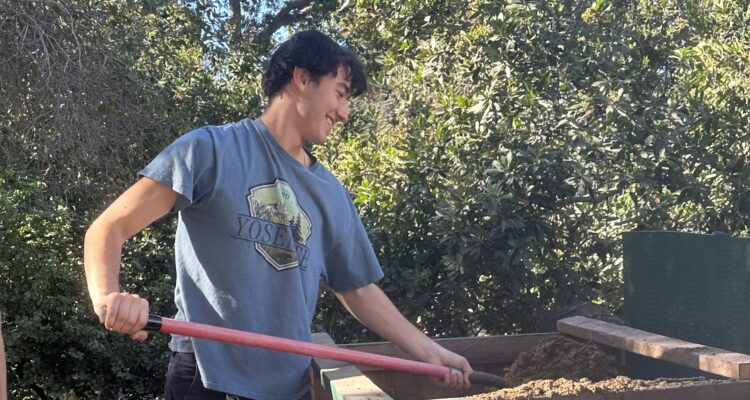
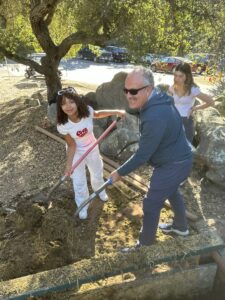
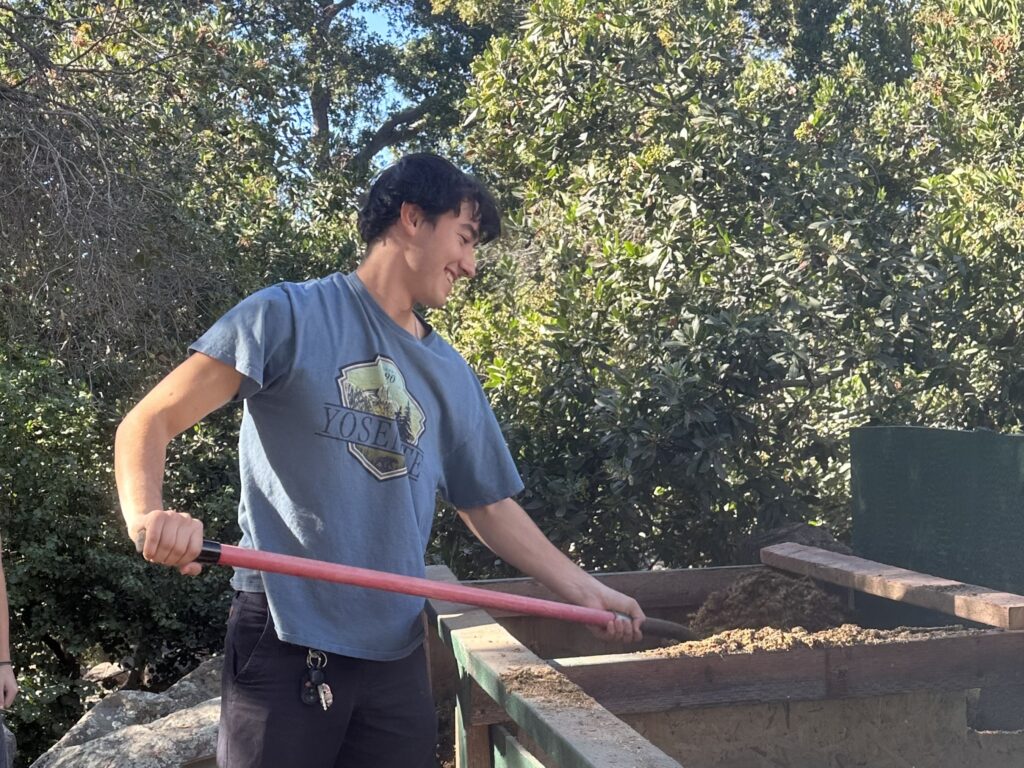
Shovels in hand, brows dewy under the blazing sun, four students and one teacher tackle the process of turning over a compost pile – a simple yet monumental undertaking that has not occurred on the OVS campus for a long time.
“If I could, I would definitely do it again,” said Laura Bell when asked if she would join the process of turning over any subsequent compost piles. “I was a bit hesitant at first, but in the end, it turned out to be really fun and a good way to benefit the community!”
This school year marks a new beginning for composting at Ojai Valley School. Although there have been efforts in the past to introduce a compost system, nothing has stuck. However, Mr. MB and the student council are working together this year to make a lasting system.
Founded by Mr. MB, the environmental and marine science teacher – and newfound director of a field-studies outdoor education program – the compost system not only educates students about where their food waste goes but also about the potential that their seeming garbage can have.
“I like the idea that by eating and consuming things, I’m producing this excess stuff that can be pretty easily made into nutrients for other living organisms with just a few simple steps,” said Mr. MB, effectively outlining how simple the process is.
The group that joined Mr. MB in the turning over of one of the first piles can attest to the straightforwardness of the procedure. “We mixed the brown and green components, including horse manure, woodchips, and food scraps from the kitchen,” said senior Alula Alderson. “It felt good to make an active effort to reduce the school’s food waste.”
In addition to an on-site pile, Mr. MB and select students are working to monitor students while they clear their plates in the cafeteria. New signs have been posted outlining which bin is for compost material (food scraps and napkins), which is for recyclable materials, which is for trash.
The food scraps from the cafeteria, in contrast to those produced by the kitchen, are transported to a composting facility in Ventura as the system on campus is not able to process fattier substances such as meat.
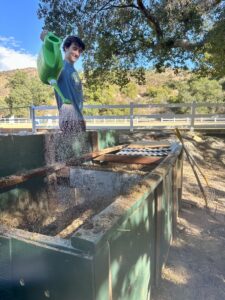
So, what are the hopes for the compost system in the future?
Mr. MB has made it clear that although he is taking a significant role in the initial set-up, management, and execution of the compost piles, he hopes to take a less prominent role in the operation in the future. “The ultimate goal is having the students here connected with where their waste goes or what can be done with their waste,” he said. “Then, we can get it to a point where it’s just a student-led initiative because that’s ultimately going to be what makes it sustainable.”
As for the significance of the project, the soil the on-site compost produces can be used in the garden elective to boost the nutritious value of the soil, benefitting the health of the plants. The compost heap is more than a big pile of old food and horse manure; it is a valuable project that will improve OVS’ sustainability.
With the help of the student council, student-led interest, and overall participation, the hope is to foster positive attitudes and relations regarding the environment for many years to come.