
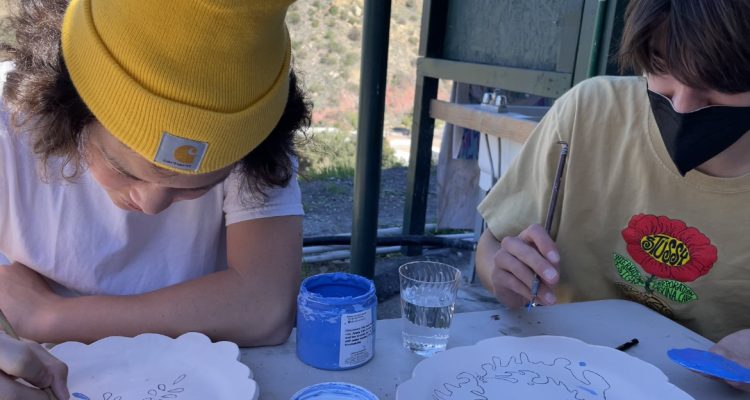
Senior Brody Moller rolls up his sleeves and leans in close to carefully paint glaze over his Majolica plate. As he works, he and his classmates discuss sports, pop culture, personal lives, and everything in between.
At some point, his classmates cracked a few jokes about their artistic skills, and everyone bursts into laughter at Spanish teacher Gretchen Wachter’s resounding call of, “¡En Espanol!”
Brody smiles as he watches his friends enjoying themselves together outside of the Spanish classroom. He won’t soon forget this experience.
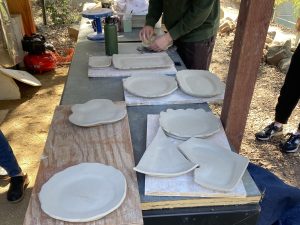
“Having this project, having everyone working in one concise area– stuff like that definitely brings us together,” said Brody
For several weeks now, the AP Spanish class at OVS has been working with ceramics teacher Margaret Haden to make plates in the Hispanic-based Majolica style.
The students were tasked with designing a plate shape, rolling out clay, cutting out the plate, and glazing it by themselves while following the traditional Majolica pottery style.
Majolica pottery – also known as Talavera pottery – is a ceramics style that’s associated with Spain, Mexico, and Italy with Muslim and Chinese influence. It’s characterized by its bright colors and depictions of nature. The parts that make it special are the clay and the glaze; this style usually uses red, earthenware clay, and tin-based glazes. It’s also a style of ceramics called “low-fire,” meaning that the pottery is fired for a longer time at a lower temperature.
The town of Puebla, Mexico, is especially famous for its majolica pottery. Ms. Haden’s fascination with the style of ceramics actually came directly from Puebla.
“My mom and dad lived in Puebla, Mexico, and they collected a bunch of Talavera pottery, so I kind of grew up with it,” Ms. Haden explained.
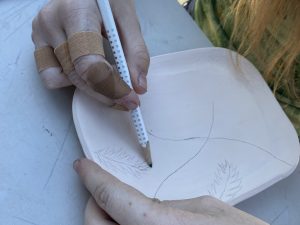
Ms. Haden has done plenty of work with Majolica pottery in her ceramics career. She’s always been interested in low-fire pottery, and growing up with Majolica pottery allowed her to appreciate the style and the culture behind it on an even deeper level.
This passion for Majolica pottery was what led Ms. Haden to approach Ms. Wachter about collaborating and helping one of Ms. Wachter’s Spanish classes do a Majolica ceramics project.
Ms. Wachter teaches several classes– Spanish II, Spanish III Honors, and AP Spanish. She decided that AP Spanish would be the best class to do this project since the focus of the class is learning and understanding Hispanic culture. She and Ms. Haden were both enthusiastic to share their love of Hispanic culture with the AP Spanish students.
“I definitely want them to gain more knowledge of the culture and more understanding of how cultures develop through mixing with other cultures,” Ms. Wachter said.
The concept of a traditional academic class, like Spanish, mixing its curriculum with an art class, like ceramics, was a new concept for both Ms. Haden and Ms. Wachter. The two both got an idea of how joint projects could work through doing this project.
“Ms. Wachter kind of took the lead on the research part, then I took the lead on the more technical side, so the building, the firing, the glazing, we both played to each other’s strengths,” Ms. Haden said.
This project was a new experience for the students, too.
Most of the AP Spanish students were inexperienced with ceramics, so they got to learn new skills and a new way of observing and appreciating Hispanic culture in their time working on this project.
The one student who is in both AP Spanish and ceramics is Emanuel Zagata-Jacobson. He loves ceramics, so he was thrilled to get to mix two of his passions during this project.
“I think it’s really cool to be able to do ceramics during Spanish class,” Emanuel said. “Ceramics is a hobby I really enjoy, and being able to do it during Spanish allows me to better understand the culture behind it, especially in Latin America.”
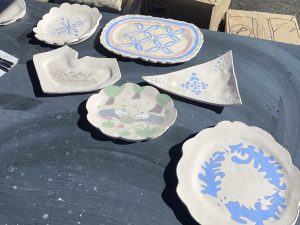
Emanuel has a recent history of ceramic work, but even the students who haven’t done a ceramics project since elementary school love this project.
“Integrating lessons with art is always fun, and I mean, ceramics is fun just to mess around with and have some fun,” Brody said.
The Majolica pottery project will conclude with the AP Spanish class and Ms. Wachter eating lunch on their freshly-fired plates at the “Mesa de Español” (Spanish table) where participants are only allowed to speak Spanish.
AP Spanish students are excitedly awaiting the day when they look down at their food-covered Majolica plate and see the culmination of all of their hard work.