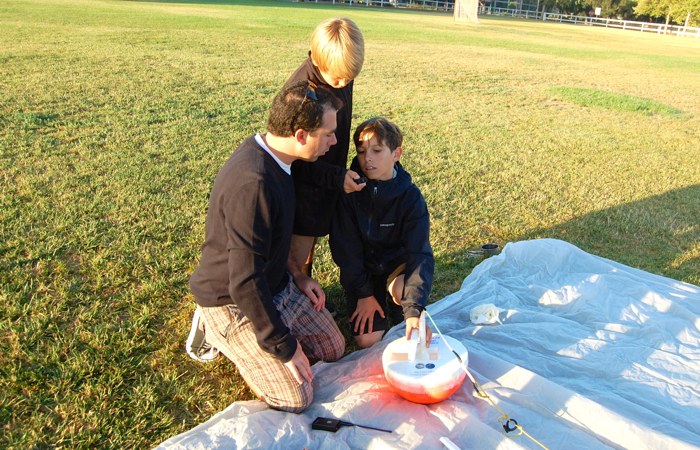
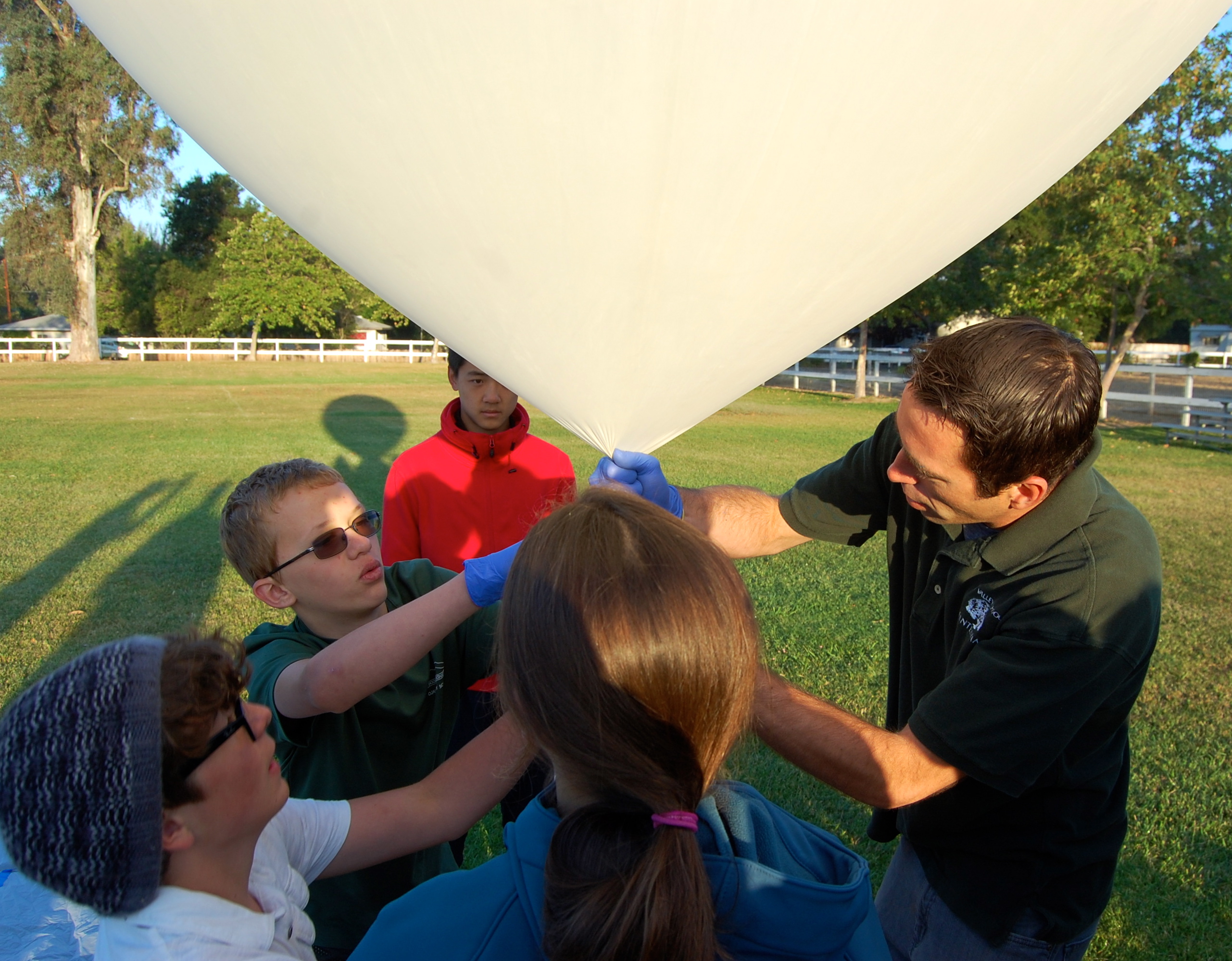
 It’s 6:49 on a Tuesday morning and a dozen middle school students are huddled around a giant white helium-filled weather balloon on the Lower Campus athletic field. Their breath is visible in the cold morning air, and their eyes are bleary from a long night crashed in the tech lab, making final calculations on a science project that they hoped would be out of this world.
On the field, the countdown begins. “10… 9… 8… 7… 6…” The students tighten their collective grip on the balloon and its long roped tail. “5… 4… 3… 2… 1…”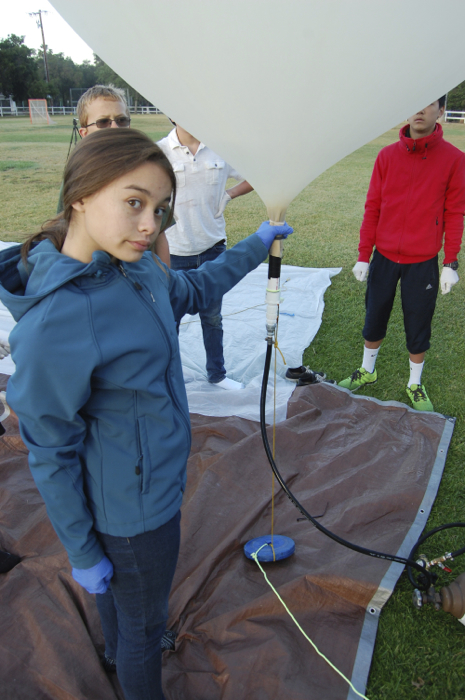
They release it — and in doing so culminate the ultimate STEAM project and become one of the first schools anyone is aware of with an actual space program. The balloon, which carried a tiny camera to capture images of the curvature of the earth and the darkness of space, traveled approximately 95 miles, reached an altitude of 82,266 ft., and at its fastest speed was traveling over 100 mph.
“We wanted to do something special that allowed students to tackle a real life problem rather than the kinds of problems presented in typical academia,” said Mike Mahon, Assistant Head of School, who launched what he dubbed Project X as a challenge to an elite, hand-picked group of technology students.
Mahon joined forces with alum Jason Goldman, who was the Mission Director for Project X, to come up with an initiative that would increase student engagement in science, technology, engineering, mathematics, and general tinkering.
“It was an amazing experience,” eighth grade team member Wendy Lazo-Dowdy told an All School audience a week after the launch. “We all launched something into space. We will remember this our entire lives.”
When the students from grades 6-8 were presented with the opportunity, they had no idea what they were signing up for. To apply for the mysterious mission, they had to write essays showcasing their STEAM qualifications and explaining how they would contribute to the team.
“Drive, grit, and passion — everything else is easy to come by,” Mr. Mahon said of the selection process. “Give me a group of driven and passionate humans and we can do anything.”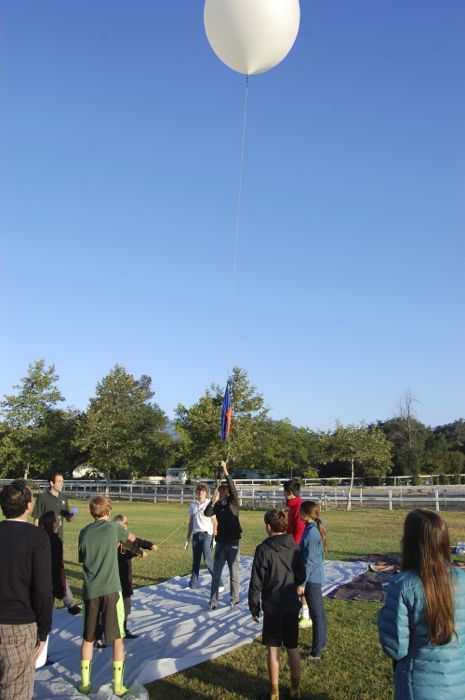
One student, Grace McHale, was assigned the role of efficiency expert based on her essay – it was only four sentences, but answered all the questions completely and succinctly.
The students chosen for the project were separated into four groups based on their specialties – the Alpha team, which was in charge of building the capsule, the Beta team, which was in charge of building the parachute, the Gama team, which was in charge of tracking and predicting the course of the capsule, and the Delta team, which was in charge of the launch and logistics.
Students worked for 12 weeks to build and understand everything possible about the weather balloon, from how much helium would be necessary for launch to where the balloon might land.
“The hardest part was creating a timeline that fit into the academic day,” Mr. Mahon said. “That is truly why OVS is special and what continues to surprise me. All teachers covet time, but when an OVS teacher hears about an opportunity like this, they bend over backwards to make it happen. Everyone was so supportive.”
And then finally, Launch Day arrived.
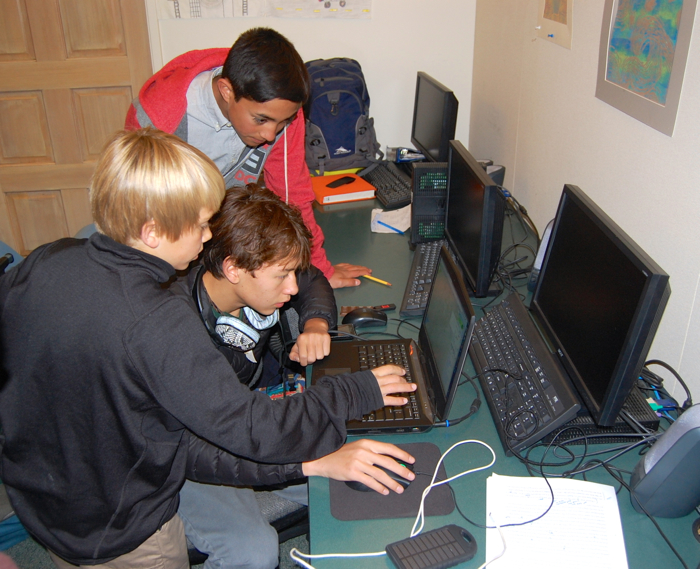
The students spent the night in the computer lab, smoothing out any last minute hiccups and getting rest so they could start preparing the balloon for launch at 5 the next morning.
Before sunrise, they began filling the balloon with helium, fashioning a rig to hold the capsule, preparing the GPS and cameras and covering the capsule with a ton of tape. A ton.
Finally, the balloon was ready for launch. They removed the weight that was holding it down, almost causing Mr. Mahon to let go of it. And after receiving permission from the FAA, it was launch time.
“It’s unbelievable that he FAA was just on the phone with a 13-year-old kid and was like ‘yep, go for it,’” Mr. Mahon said.
Following the launch, the recovery team set out in a van, intent on locating their hard work. Unfortunately, the capsule landed in the Juniper Hills just south of Palmdale, making the retrieval mission much more difficult. Two efforts to locate it thus far have been unsuccessful, but mission leaders intend to launch a third search party after graduation next week.
“We know exactly where it is but can’t get to it yet because there’s an endangered toad in the area and we can’t drive there,” Mr. Goldman said. “We were very successful with the biggest challenges. The balloon worked perfectly and it went exactly where we predicted it would.”
Once they do retrieve the capsule, the team will study the footage and pat themselves on the back before planning the next mission.
Project X is the first of what will hopefully be many ventures into space. Part of the mission was to establish a space program by conducting a series of mission activities high above the Earth
“It’s my belief that within the span of my career, OVS will put something into orbit,” Mr. Mahon said. “Everyone I know laughs at me when I say that, but dreaming big and inspiring others is the noblest end of scientific and technological pursuits. I can’t wait to say, ‘I told you so.’ ”