

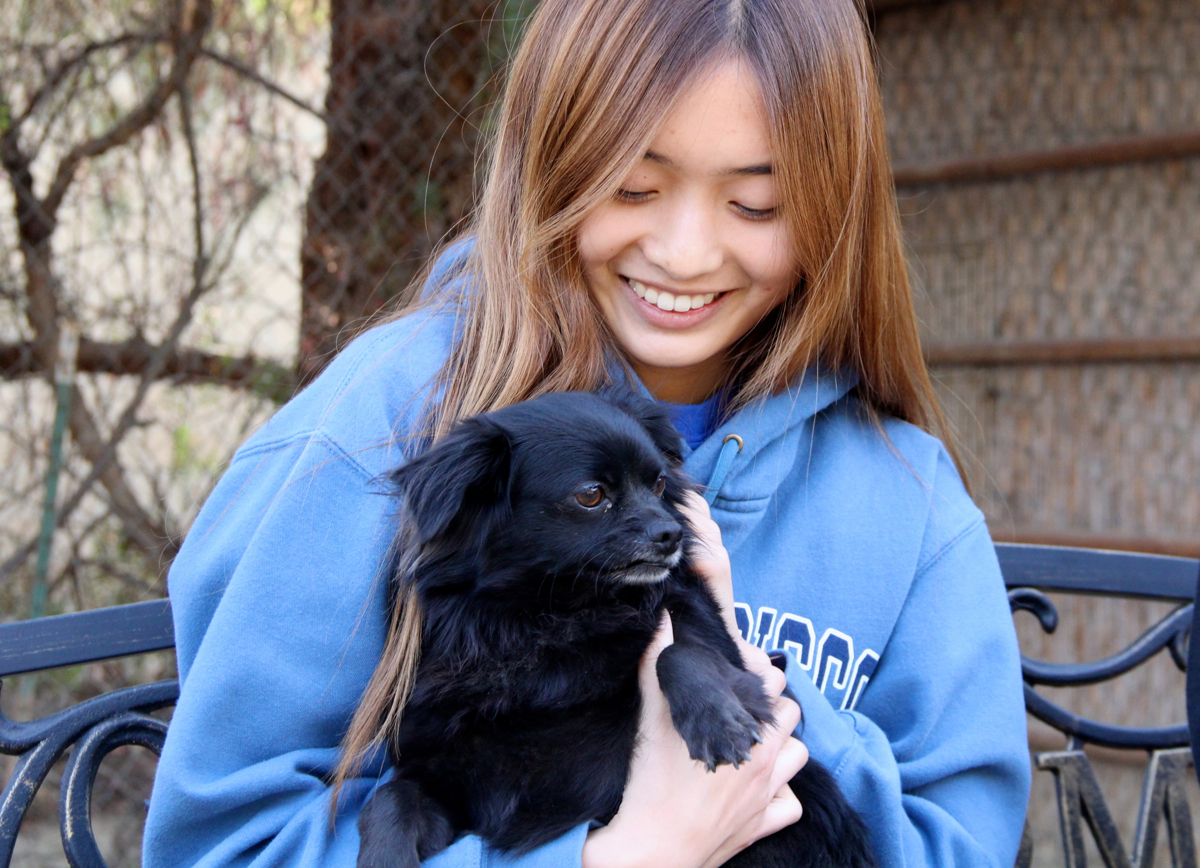
There are two kinds of dogs; the kind that sit and wait patiently, and the kind that try to jump straight into your arms.
OVS Junior Pinky Cheng has been volunteering at the Humane Society of Ventura County since her sophomore year, and she is usually drawn to the patient dogs.

On a recent Tuesday afternoon, she sat with a small quiet dog – the kind that simply enjoys the presence of the humans. He leaned back against Pinky, eyes watching hers, as if attempting to stay as close as possible as she hugged him to her chest.
Pinky could be in her dorm room for the afternoon, studying or just relaxing. But she said she is eagerly willing to give up one afternoon a week to go to the animal shelter.
“It [gets the] animals used to people so they can be adopted easier,” Pinky explained. “It’s sad to see the dogs abandoned, and they’re super cute and fun to play with.”
Cuddly dogs, prancy kittens, and an hour off the hill. That’s what Ojai Valley School students get every week when they head to the Humane Society of Ventura County to take part in one of the school’s longest-running community service projects.
The first step into the kennels reveals dogs sitting darkly behind wire doors. The instant a dog gets a whiff of a human a bark goes out – and another, and another, and another, as if the dogs are saying, “the humans are here! We’re going to get taken out for walks! We’re going to get petted!”
Former OVS English teacher Judy Oberlander is believed to have launched the community service project back in 1999. She worked side by side with the students and ended up adopting her cat Ray from the shelter.
“I do know the desire to do things like the Humane Society came out of a realization that we needed to get the kids off campus doing community service,” Ms. Oberlander said.
As a no-kill shelter, any animals that were “thrown away” are brought to the Ventura County shelter to be “recycled,” and the students are the key to that, Shelter Director Jolene Hoffman said.

“An animal that has been socialized is an animal that we can place,” Ms. Hoffman said.
The amount of students traveling to the shelter varies from week to week, ranging from five students to two full vans of sixteen. Driving the vans and participating in the volunteering are English and history teacher Terry Wilson and girls’ dorm parent Emily Dodi.
Returning students confidently troop into the office of the shelter to sign in, while new recruits meander back and fourth awaiting training.
Training is a simple process; the students are told how to handle the animals. Pamphlets on animal body language are handed out, and then students get to walk some small dogs.
At the end of the cuddling sessions satisfied students – covered in hair, slobber, and paw prints – return to school for sports.
While some day students volunteer at the shelter, resident students are the more common volunteer.

“I think [that is] because many resident students don’t have their own animals,” Mrs. Wilson. “They have an opportunity to connect with an animal, to hug an cat or a dog, feel the warmth that animals can provide back to you.”
Junior Rebecca Nee is a fond cat-lover, and seems to understand that cats are pickier about which humans get to pet them. She sneaks into the cat room and sits, either on the ground or on a wooden cat house, quietly until a shy cat decides to investigate her.
Now there are two kinds of cats; the kind that like affection and the kind that pretend to not like affection. Affectionate cats will curl up right into Rebecca’s lap, while the more attitudinal cats will circle her before reluctantly shoving their faces into her hand.
“I go for the cats because most of them were abandoned,” Rebecca said, “I feel I have the duty to make them know the world better and know people better, and to live happier.”