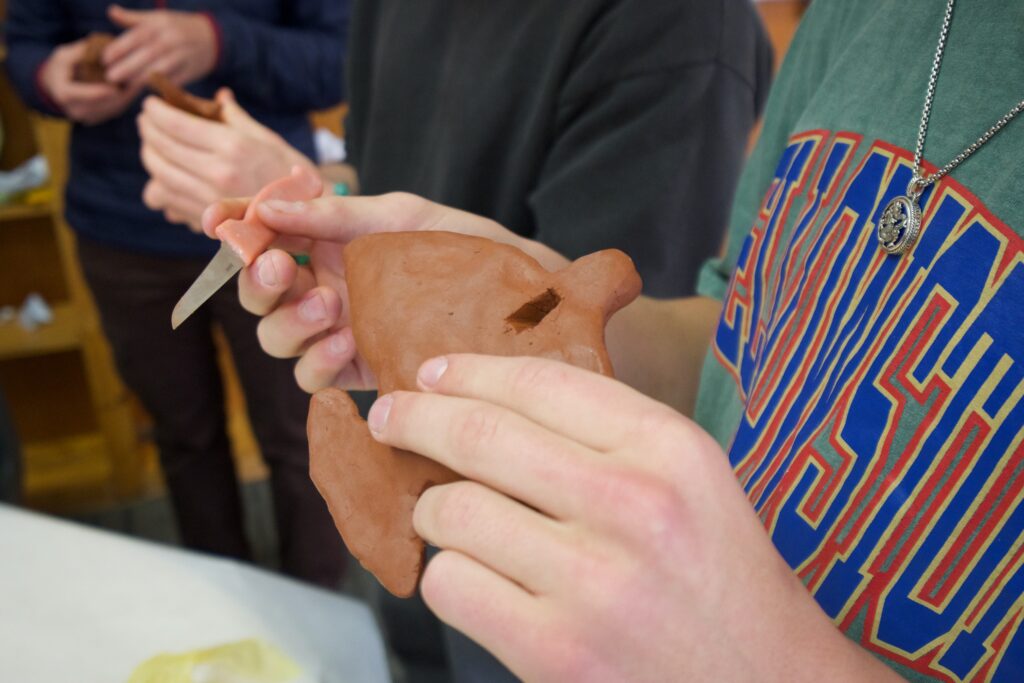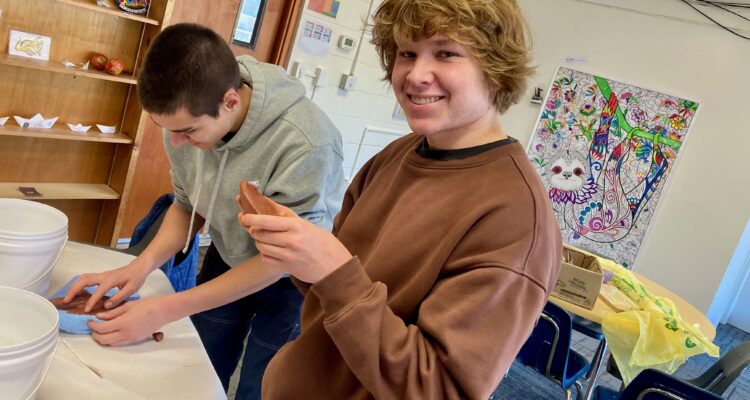
Upon entering the Spanish classroom, no one expected to see a whole zoo of animals. Recently, nonetheless, Classroom Six has been the dwelling of sea creatures like fish, whales, and turtles as well as land animals such as birds and armadillos.
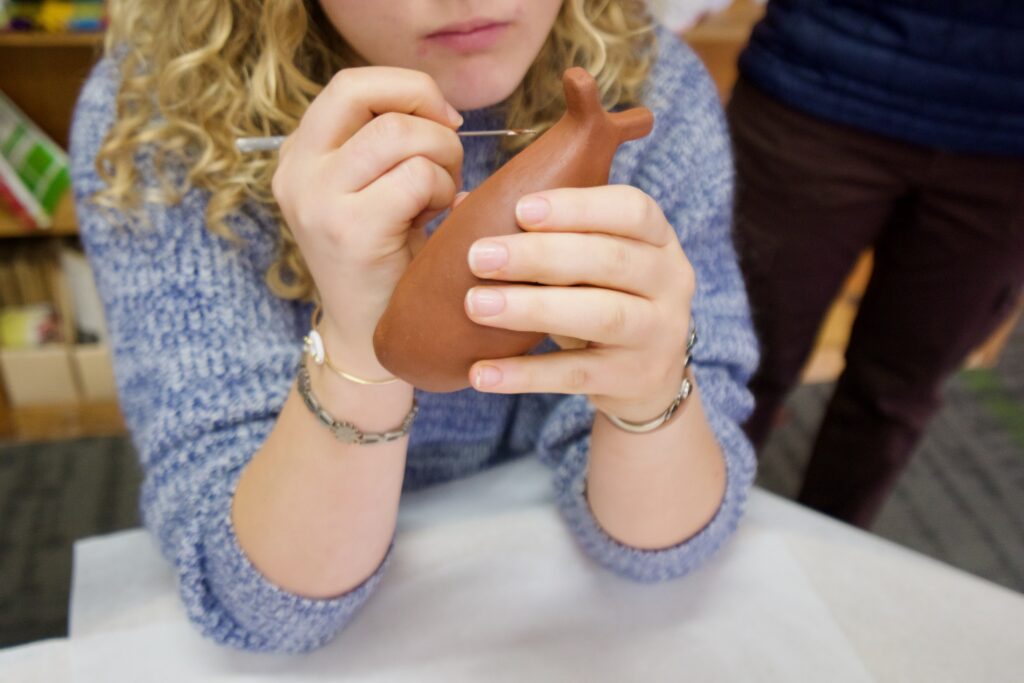
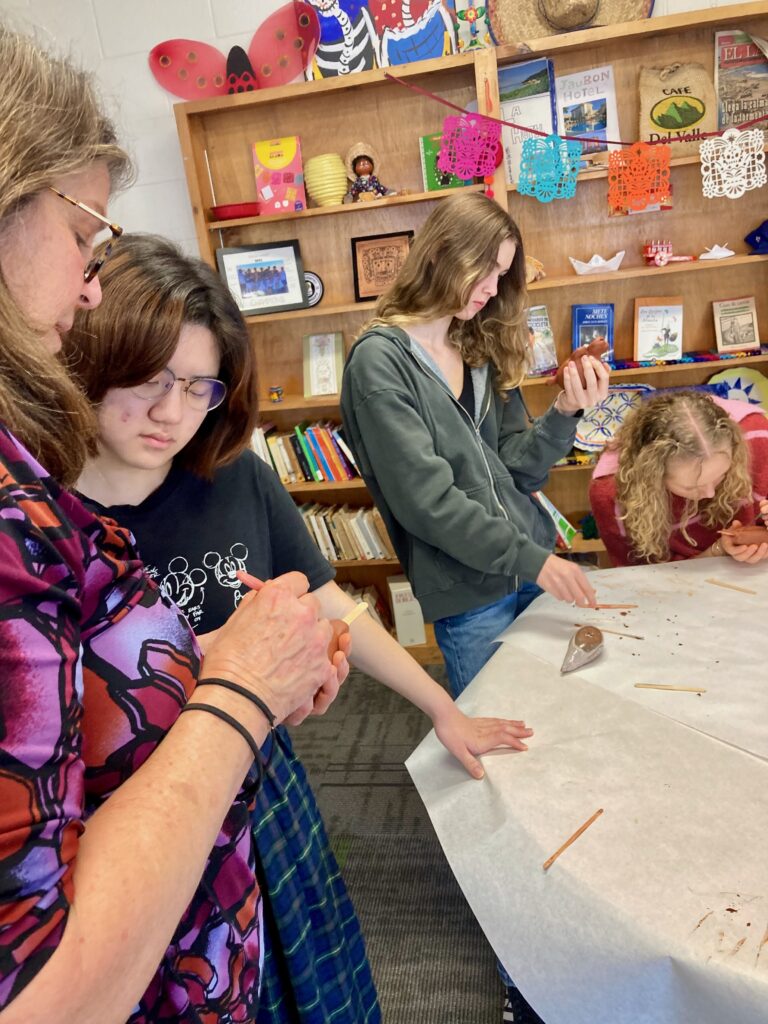
Although you would not immediately assume that the courses of ceramics and Spanish could find much common ground, you could not be more wrong. Recently, AP Spanish Language teacher Gretchen Wachter brought in ceramics teacher Crystal Davis to help direct five AP Spanish students through the process of making ocarinas – wind instruments typically created out of clay.
“Learning a language is not just about conjugating verbs and learning vocabulary,” Ms. Davis said. “It’s about seeing and understanding the culture that the language arose from and how that language is shaped by such culture.”
 One of the most unique aspects of the curriculum at Ojai Valley School is its ability to cross seemingly dissimilar academic missions. Additionally, at a school that represents a primarily white student body and faculty, opportunities to explore cultures from around the world are always an excellent possibility for some global exposure and broadening of ethnic horizons.
Ocarinas have a rich history. They consist of a main body with a mouthpiece and holes to blow and adjust the pitch of the sound. The earliest records of such instruments are believed to be dated back over 12,000 years. One of the most unique qualities of their history is the fact that they were popularized simultaneously in different cultures that only accessed each other centuries after the creation of the ocarina.
 Forms of the instrument differed from culture to culture, yet the main idea of the clay remained the same. Evidence of ocarinas has been found in Asian cultures – specifically Chinese – as well as numerous old Mesoamerican societies. Even without contact, ocarinas persisted in playing important roles in the musical culture of two very different civilizations in concurrent periods.
Ms. Wachter saw the opportunity to provide a unique cultural as well as artistic opportunity to her AP Spanish students, and she took it. Coordinating with Ms. Davis, the students set out to create their own functioning ocarinas and later write and present on the subject and history.
As for their ocarinas, Ms. Wachter instructed her students to make a shape representative of Mesoamerica, particularly embodying an animal of their choice native to the area. Additionally, the decorations would similarly represent Mesoamerican tradition.
“It was fun to experiment with cultures from other places around the world,” junior Oliver Ayala said. “It also got me more interested in the class in general and gave me a good historical context for people in Mesoamerica.”
As well as looking back on the history of ocarina-making, some students are looking more into the future.
“Next year, I am looking forward to more interdisciplinary learning in college, so it was cool to get a taste of that now,” senior Alula Alderson said. “It also was a more fun and engaging way to learn!”
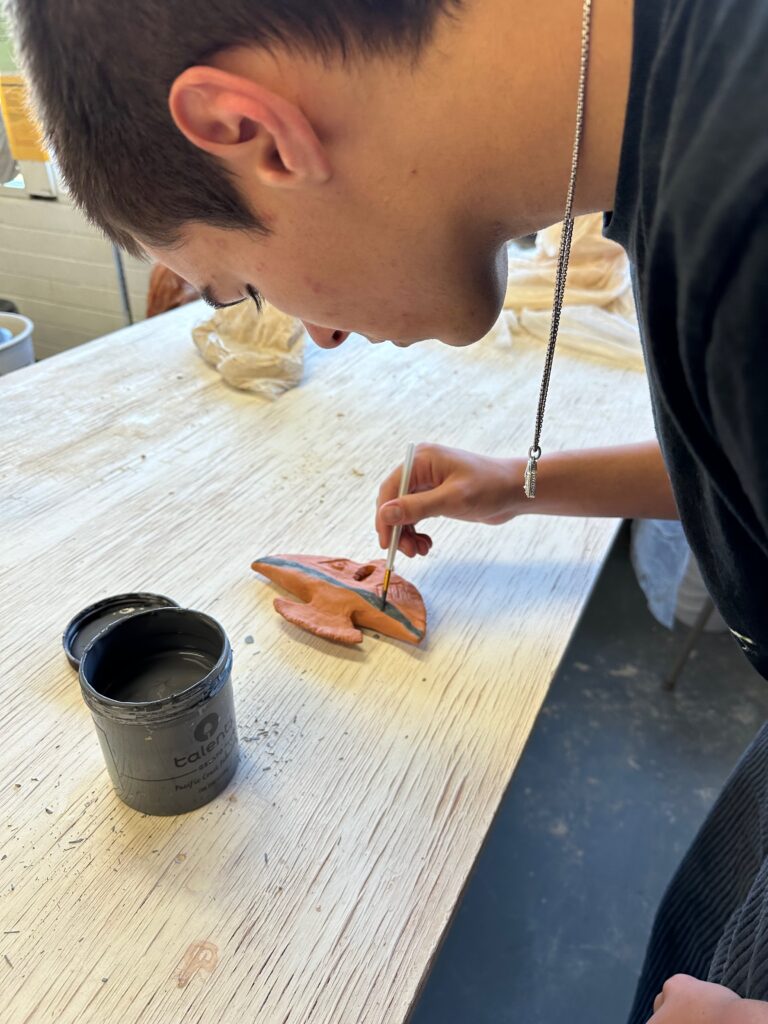 Ms. Wachter similarly comments on the future upsides of a type of learning that combines numerous subjects and likes that it relates more to real life than other single-lens focused classes. She outlines that many jobs integrate numerous skill sets into one service, meaning that such a method of learning in school can highly benefit the students.
The experience culminated by Ms. Wachter and Ms. Davis proved to be influential and inspiring for the students and will hopefully open up further opportunities to combine different aspects of academics and different cultures to learn from each other.
“As humans, we spend a lot of time thinking about our differences, even though we are all a lot more alike than we are different,” Ms. Davis said. “After we fulfill the physical needs, the need to make music is beautifully profound and universal.”