
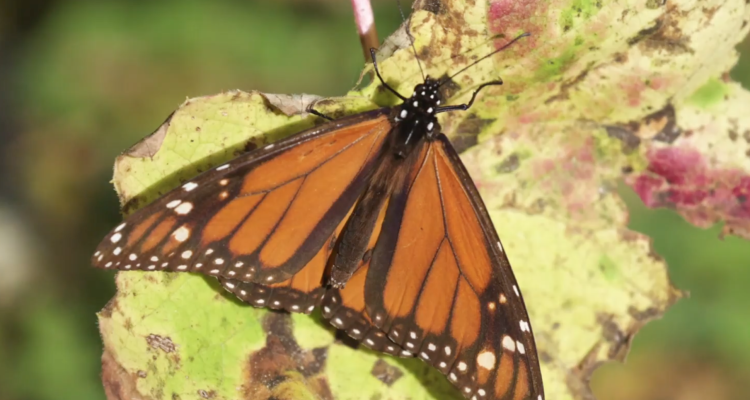
OVS is ready to welcome back a new generation of Western monarch butterflies to the Upper Campus.
Students and teachers recently planted a new patch of milkweed on the hillside opposite the ceramics room in the hopes of luring the imperiled, black-and-orange winged insects back to campus.
Going back more than 10 years, OVS had a large, thriving population of Western monarchs, as the campus community – including students, teachers, and other staff members – dedicated itself to the protection and proliferation of these delicate creatures.
Key to that conservation effort were clusters of Narrowleaf milkweed plants that used to grow in abundance in front of the old Upper Campus science building. The entire lifecycle of the Monarch butterfly is dependent on milkweed – female Monarchs lay their eggs on the underside of milkweed leaves, and milkweed is the only plant on which Monarch larvae feed.
Unfortunately, the milkweed habitat was lost in the Thomas Fire in 2017, which destroyed half the Upper Campus, including the science and technology building where a majority of the milkweed thrived.
However, OVS is presently trying to reestablish the milkweed and invite those butterflies to come back again.
Milkweed was found growing on campus this year after the restoration of new buildings.
On Martin Luther King Junior Day, as part of the school’s Day of Service, math teacher Soren Stewart led a group of students to transplant milkweed from different parts of campus to the hillside next to the Garrett Steps.
“[The milkweed] will hopefully grow up into some bigger bushes, and that’s going to be a stopping point for monarchs,” Mr. Stewart said.
The monarchs can use all the help they can get.
According to a December 2020 story in the New York Times, the Western monarch population is in deep trouble. That population stood in the millions in the 1980s, but by 2017 that population had collapsed to 200,000. In a 2018 count, the tally fell to about 30,000.
The decline is part of a larger trend among dozens of butterfly species in the West, according to the newspaper, and researchers cite a variety of factors including habitat loss, development, climate change, and widespread use of pesticides by farmers.
In 2020 the California Fish and Wildlife Service found sufficient evidence to place the monarch butterfly on the Endangered Species list, and it is currently slated to be listed in 2024..
At OVS, the founder of the milkweed preservation project, English teacher and Assistant Head of School Cyrstal Davis, is passionate about guarding monarch butterflies.
Before the Thomas Fire, she created signs to educate the community about the milkweed habitat and raise awareness about native plants and biodiversity.
She also organized students to help to weed out invasive plant species so that the milkweed could survive.
“It [monarch butterflies] has an ethical right to exist,” Ms. Davis said. “We should honor that even if we can’t see a real value that it has worked.”
In past years, monarch butterflies attracted significant interest from students when they overwintered at the Upper Campus. Students learned about the butterflies in biology class and created images of the butterflies in their art classes.
“The beauty of this project, and of teaching in general is when I begin to see students take on the project as their own and become invested in it,” Ms. Davis said. “That’s what I’m hoping will happen again.”