
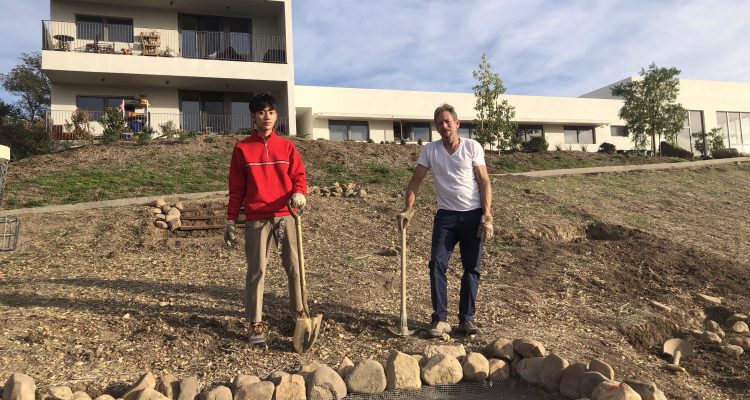
Sitting out on the edge of the girls dorm, a new project is sprouting.
Behind the Grace Hobson Smith House, three rock garden beds have already been built, holding the promise of pumpkins, beans, and corn.
Right now it’s a three man operation, with Spanish and AP Environmental Science teacher Steve Risser, sophomore Tristan Phelps and junior Sean Wu.
“It’s nice to have an area coming to life,” Sean said. “It’s been given a purpose other than just letting weeds grow.”
Hopefully by next semester, the garden will be delivering its first bounty.
To honor the indigenous people, native plants and an indigenous planting method will be included in the garden.
“We can get some Mexican sage and different native plants or flowers, and we can have a garden that looks good, hopefully also produces a little bit of food,” said Mr. Risser.
“Sean has contributed a lot to the garden,” Mr. Risser said. “He also has a good eye for landscape design.”
Sean introduced the “Three Sister Planting Method,” a planting method used by the Haudenosauneethe tribe, also known as the Iroquois. It is an efficient, environmentally friendly, and mutually beneficial way of planting where pumpkins, corn, and beans grow together and support each other.
“The bean vines grow on top of the corn, and the pumpkin patch creates a living mulch. They grow really well together,” Sean said, explaining the method.
Mr. Risser says the garden will never really be finished, and he encourages students who want to take part to join the effort.
Besides native plants, they plan to add benches to the garden. This way, students can sit down and spend time together while enjoying the garden and the view of the mountains.
“There’s no garden in Ojai that has a better view than this,” Mr. Risser said. “I would almost bet $100.”