
No one left behind.
That’s been the attitude adopted by all connected to Ojai Valley School in the wake of the Thomas Fire, as hundreds of students, teachers, alums and supporters of OVS have turned out in recent weeks to help the school reopen and rebuild.
And for a small group of Boy Scouts, led by Upper Campus Assistant Head of School Crystal Davis, that has included fending for those who can’t fend for themselves: Ojai’s native birds.
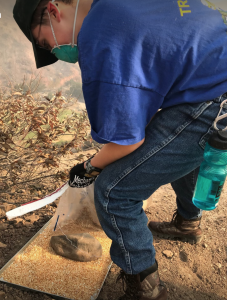
Photo by Crystal Davis
In mid-December, members of Boy Scouts of America Troop 243 fanned out across the Upper Campus to construct feeding and watering stations for native birds, the first in a series of restoration projects aimed at helping the school recover from the devastation of last month’s wildfire.
Ms. Davis proposed the idea to sophomore and longtime scout Aaron Wolf while he was visiting the Upper Campus with his family in the days immediately after fire swept through campus and destroyed surrounding habitat and signature buildings, including the girls’ dorm and the Science and Technology center.
“I was prompted to this particular project because many in the Ojai community were suggesting planting seeds as a method to ‘restore’ the hillsides,” Ms. Davis said. “This remains a very bad idea for a number of reasons, and it reflects a lack of information about how chaparral ecosystems are adapted to recover after fires.”
The idea to provide food and water for native birds developed from there.
For more than two hours in mid-December, Aaron, freshman Ethan Gao (who is also a Boy Scout), and the rest of Troop 234, as well as some younger Cub Scouts, scoured the hills around campus.
First they found a location that provided cover, such as structures or vegetation, then placed shallow water troughs and trays of seed for birds like California Quail, towhees, and doves.
“We wanted to give our resident native birds a boost during this recovery period,” said Ms. Davis, who has long been passionate about community service and ecosystem conservation.
While this project directly benefited the community’s wildlife, it also provided a learning experience for many of those involved.

“The nine year olds really didn’t know the effects of the fire because they lived in Port Hueneme,” Aaron commented. “They only heard about it from the news and the smoke they saw in LA. So seeing the scorched mountainsides and burnt down buildings really made them realize that the fire had consequences.”
During the school’s recent community work days, which drew hundreds of volunteers to help reopen the Upper Campus for the second semester, Aaron headed up a small group dedicated to refilling the wildlife stations, and those water and seed trays will continue to be maintained.
Looking forward, the members of Troop 234 plan to return for future service projects such as reconstructing the wooden fences that flank the school’s solar panels.
“Connecting Troop 234 with the restoration projects at Upper was an interesting experience because it brought together two worlds that had remained disparate for years,” Aaron said. “It was refreshing to see how these two very different groups of people, with practically nothing in common. We were able to come together and work towards a greater cause.”